Achille Bonito Oliva
curator

|
Palazzo delle Esposizioni museum
"GAPscape - State of Art - Italia"
Rome, May 2016
|
|
Art is an enquiry on the world, and the artist is its special envoy in reality.
Art massages the atrophied muscle of collective sensitivity. Art is a catastrophic disruption in the equilibrium of interpersonal communication. Paradoxically it is the ability of relating and playing between catastrophe and communication, and Minya handles both these aspects with balance.
...more
|
Through rupture and linguistic catastrophe she creates personal images starting from her observation of the world and its realities. And at the other end, through form, she communicates the favourable outcome of this catastrophic act. This time, the catastrophic act was the search for excellences within the social reality surrounding the artist and her audience; excellences on the moral and social planes, in terms of economic and political achievement, figures who through their behaviour have been capable of adding value to their country’s identity; in this case, Italy.
Rhetoric of old tells us that Italy is a country of poets, warriors and sailors. The range of characters chosen by the artist is well documented by their personal stories and, I should add, by their aptitude to be transfigured into icons.
This catastrophic intervention on language is successful because the artist uses an absolutely personal technique. She effectively brings to surface with pixels and manual ability the figures, the representation, the transposition of recognizable characters from life to the work of art. Their familiarity is such thanks to their passage through a linguistic grill. A formal, original system that shows us how art which comes forth from moral impetuosity is in itself a question, holding an adequate and accurate linguistic answer.
This figuration produces a gallery, a sample of existing, behavioural, professional excellences who provide a behavioural model through the contemplation the public has towards them, thus contributing, while motionless, through this new iconography, to develop and massage the atrophied muscle of collective sensitivity.
This collectively organized social endeavour hence produces new processes of knowledge creation. In our case, the awareness of new ways of producing images, of painting, while on the other hand, the capability of creating, illustrating the history of our country.
Nicola Zingaretti
President of Regione Lazio

|
Palazzo delle Esposizioni museum
"GAPscape - State of Art - Italia"
Rome, May 2016
|
|
“GAPscape – STATE OF ART – ITALIA” expresses the flair of the original and contemporary artist Minya, providing a dynamic, positive idea of Italy as a forge for talents, a land of ingenuity and passionate professionals. For this reason, Lazio Region has chosen to support this cultural project, which counts on the precious contribution of Achille Bonito Oliva, its promoter.
...more
|
Additionally, Minya chose to portray me - along over thirty others – in his project, adding an element of personal emotion for me. In this double role of protagonist and viewer, I observe and appreciate this work of great artistic value and impact. Minya has selected faces of men and women from different professional segments: from art to sports, from show business to politics, from civil engagement to humanitarian effort. The author defines these men and women as “ambassadors of made Italy”, valued national and international assets. Figures from many different Italian cities, all joined together in the representation of the “body” and “soul” of our Country. Minya has succeeded in immortalizing a heritage of places and people who have now become a common heritage. This is clearly an innovative, modern, vibrant project, a project that stands out from many others.
Giovanni Malagò
President of Italian National Olympic Committee (CONI)

|
Palazzo delle Esposizioni museum
"GAPscape - State of Art - Italia"
Rome, May 2016
|
|
An artistic project that leaves a mark. That celebrates the excellence of the Made in Italy by emphasizing – through special portraits – the outstanding value of our country thanks to the uniqueness of the people who characterize it. Achille Bonito Oliva has put together many small works of art and with the support of Minya has produced a project that could become the most effective visiting card for promoting a winning image of the Italian tradition, and to support us in the challenges we have to face including the Olympic challenge of Rome 2024.
...more
|
Many protagonists, but one common denominator: the sense of belonging to our roots, the legitimate pride of representing and upholding a tradition mirrored in success. I am particularly proud that this project has a strong athletic matrix, and I’m not speaking of myself but of the athletes, the champions who are bearers of the very best image of our nation, who write history through their example of talent and determination, because every finish line is reached with self-sacrifice and determination. The project is a lesson reflected in our everyday life, that makes sport into a life style, a concept that this prestigious gallery has been able to enhance with masterly artist flair. It is the projection of a culture that distinguishes us, of a universal language that embraces many different fields. It is a project that communicates through the sinuosity and elegance of outlines, through the expression of tonalities, through the richness of details. It is an inestimable heritage that we must safeguard in order to nurture the history of Italy.
Mario De Simoni
Director General of Palazzo delle Esposizioni museum

|
Palazzo delle Esposizioni museum
"GAPscape - State of Art - Italia"
Rome, May 2016
|
|
Palazzo delle Esposizioni is delighted to host “GAPScape – STATE of ART – Italia”, a project promoted and curated by Achille Bonito Oliva, that ideally opens the path to Rome’s candidacy as host to the 2024 Olympic Games. For this reason, the exhibition displaying the works of art by Minya, portraits of many of the outstanding Italians of today, comes to us with the support of the Committee for Rome 2024.
...more
|
A joint effort on behalf of all the Country’s forces to back this great endeavor, an enterprise in which culture, in its multiple settings and manifestations, may express a leading role in national affairs. This event is such an occasion, a project that gathers together the great thought provoker and advocate for culture that is Bonito Oliva, Minya, the original artist very perceptive of issues concerning communication, the generous, open disposition of the many personages who lent themselves to be pictured, and an important venue such as the Palazzo delle Esposizioni.
We are certain the spirit of intellectual and institutional cooperation materialized in the realization of the project “GAPscape – STATE of ART – Italia” should and shall follow the entire path of Rome’s candidacy for the 2024 Olympic Games.
Corriere della Sera
"Minya Mikic, celebrities made in Italy"
May 2016
La Repubblica
"Rome, the icons by Mikic at Palazzo delle Esposizioni"
May 2016
ANSA
"Minya, the excellences from Eco to Bocelli"
May 2016
La Repubblica
"Made in Italy" - Incredible Bebe Vio: fencing is life
May 2016
Exibart
"State of Art in Italy "
May 2016
La Voce
Minya Mikic's "GAPscape"
May 2016
Loredana Barillaro
curator

|
solo exhibition in Ellebi gallery
"Visual communication that tells the story of humanity"
Cosenza, April 2012
|
| A discourse that is never one-sided, the one woven through Minya's works, through words that are not really words, but which translate — as in an archaic past — into lines and symbols. No rhetoric, no evocation of languages that once were, yet it is necessary to allude to them, since it is from there that the artist sets out to illustrate her journey. A journey spanning ten years that recounts the mechanisms of communication, so ever-changing: from cave art, with its graffiti, to the present day, an era in which technology moves at extreme speeds. A reflection on language and around language.
...more
|
Perhaps a new street artist? But not in the sense we all know — hers is a nomadic action that leaves no permanent mark on the surface upon which it "rests". It creates a give and take, from the geographical-spatial context to that of the painted surface, when this is a plexiglass sheet — as an extension and evolution of the canvas — a material that, being entirely non-invasive, allows the artist a singular intervention upon the landscape. Perhaps a performance whose outcome could be a post-production documentation. An itinerary, an engraved map, just as her works appear engraved — trails of stories narrating human events across fragmented, rough surfaces. Minya simulates the pixels of digital images, creating a line of connection between the present and the past, producing captivating planes that are both tactile and visual. A continuous research, both technical and of thought, a steady journey without flights of fancy, yet one that allows her to achieve ever-new results in works that evolve over the years.
In Minya's works, the lines and movements — sometimes sinuous, at times scratching and nervous — constitute the human, primordial element upon contemporary materials. And so the free gesture stands alongside rule and method, so necessary to express the idea. Perhaps Minya constructs a body: there is the soul, and there is the flesh. A marked, engraved flesh, that transforms its nature to become something other than itself. Layers of matter like layers of distant epochs rising to the surface through cuts, tunnels, or reliefs. Almost a parallel world, the negative image of what lies on this side. It is never an absolute letting go, it is not chaos. Segmented figures, recomposed, around which our movement, perhaps, is nothing other than a ritual dance, ready, once again, to lead us back through time. But a plexiglass surface is not only transparency — it is determination and will, for here, there is no going back.
Standing before the wall, one grasps the essence — the pictorial element that acquires, through it, a particular three-dimensionality, particular because it is intangible, shifting with the shifting of light. A plexiglass "painting" never ends, but changes, evolves in its inevitable encounter with what lies beyond and around it.
GAPscape is precisely this — observing, peering through cracks and fissures — and Minya's Urban Art is one that acts upon the landscape, perhaps drawing its very origin from it. Places like New York, Rome, London, alter their appearance, their nature, and at the same time the "painting" becomes a classical element or loudly proclaims its contemporaneity. It is no longer a matter of absorbing the "text" within the confines of the canvas, granting it "eternal life", but rather an experience of the here and now — and never a one-way experience.
Her artistic journey does not stop here, and so other subjects, new formal experimentations take shape in her work — portraits. Here, more than anywhere else, the lights, the shadows, the lines of faces, the gazes, are the result of a perspectival interplay between the inside and the outside. She adds when something is missing, and steps back to watch when it is the light that intervenes.
Works that are mutable, then — modifying and being modified in relation to their context. Minya intervenes to organise space, and does so with simple "rules", without any imposition, merely providing a tool for an observation that is as subjective as possible. There is no before and after — there is simply a shifting and simultaneous vision, around which "ancestral" movements recall its origin.
Andrea Palermo
art critic

|
Edieuropa gallery
"Primordial Languages in Minya's Modern Conception"
Rome, April 2011
|
| In the ancestral memory of mankind, symbols lie at the foundation of traditions handed down through time. First among these were those who left upon rock the indelible marks that speak of times infinitely distant, yet which find space in our thoughts, erasing oblivion from the mists of history. Figures drawn, sculpted, born from the fascinated gaze of the first men who looked upon the majestic creation of nature not as mere spectators, but as actors capable of deciding the fate of humanity through their actions and their transcribed languages — conscious of leaving to posterity the alchemical recipe of immortality, which only art can bestow upon mankind.
...more
|
The symbols with which the exceptionally talented artist Minya speaks to the art world today are not merely the product of a modern language, but arrive directly from those cave paintings that remain imprinted in her mind and which now re-emerge in all their chromatic and symbolic beauty throughout her works.
Her art seems to merge with the history of her Serbian origins, in the beautiful city of Novi Sad — an ancient city inhabited over 4,500 years ago by Palaeolithic settlements — and those men and those symbols have found in Minya the worthy custodian of their ancestral messages.
Minya is not simply an artist who paints her canvases to please the eyes of the public; she seeks to speak through colours and her sinuous figures to all those who pause to admire her works. Within them lies hidden the mystery of the birth of life, in the swirling passages that await the human being so that their existence may come to light.
Through her abstract art, the artist intends to convey, metaphorically, the hidden logos of the history of the image — for each work has its own language and its own independent story, and admits no repetition.
Her paintings are born upon elements destined to become servants of the light, which projects them into an unreal dimension concealed only by the dreamless lack of the modern man.
Those who dare to dream and look beyond Minya's works discover the beauty of time's passage in each of its moments. Even a single minute can prove fundamental to understanding them, for as they are traversed by the ever-changing reflection of light — which inexorably grants time the honour of arms — every minute spent intensely admiring those endless roads of colour makes us aware that her paintings have no fixed place in time. They are time itself, passing and projecting onto them the dimension of being — but only if one so wishes — or of non-being, if one allows oneself to be consumed by modern thought, which rests its gaze only at the first flutter of an eyelash.
The pure pigments with which Minya works are that indissoluble bond between the ancient and the modern, between primordial languages and today's expressions born from a new conception of graphic design technology. She intends her works to be a testament to posterity of her very self — simple and delicate in the gentle flow of pastel colours, yet strong and proud in the fire-red scratches fuelled by a passion for art, which is the foundation for those who wish to leave behind works that are not anonymous, but enduring through time.
With her way of interpreting informal art, Minya becomes metaphorically the fulcrum of an hourglass, through which the sands of a pictorial and interpretative past flow through the first chamber, only to be recast in a modern and emblematic key in the second.
Her very being is perpetually divided between what has been and what will be — between her present life in Rome, the city that emblematises the ancient world, and ultra-modern New York, the metropolis as expression of the future; between the canvas, the support upon which she exalts the colours of the real and visible world, and plexiglass, upon which light-hungry figures are projected into their deepest dimension.
"I love to experiment and play, exploring ever-different techniques... I very much enjoy working with pigments... creating strong contrasts using opposing materials such as plexiglass and natural pigments." With this outlook, Minya aims to astonish the world of modern art, ever in search of new expressive and communicative languages capable of surprising the viewer. Each work stands alone, each has its own precise place, each deceives and persuades the gaze, each conveys different sensations, each is born with a specific title that situates it within the deepest reflection of human understanding.
GAPscape — this is the term by which to define her art, and with which Minya herself defines it: that going beyond every conception, the irrepressible search for the urban legend of being and non-being, of that ancestral doorway that allows one to pass beyond the beyond of every dimension — that infinite temporal fissure, the dream of the human soul.
Minya, daughter of artists, completed her studies at the Academy of Fine Arts in Novi Sad and taught Graphic Design. Before graduating in 1999, she moved to Rome, where she lives and works.
Over the years she has held numerous exhibitions throughout Italy, including a wonderful open-air show in the shadow of the Colosseum, before arriving in 2006 on the exhibition scene of New York, in the heart of the celebrated Manhattan.
Pablo Picasso once said: "Painting is a blind man's profession: one does not paint what one sees, but what one feels, what one tells oneself about what one has seen." Enclosed within this aphorism lies Minya's art.
Corriere della Sera
"Minya in dialogue with history"
May 2010
Golf & Eventi
Golf & Eventi magazine reports on it's full second page about Minya's solo exhibition in galleria Tartaruga in Rome
agosto 2010
Italia Sera
Valleria Bittarelli from "Italia Sera" reports on Minya's exhibition in "Galleria della Tartaruga"
June 2010
Il Messaggero
Art critic Danilo Maestosi in "Il Messaggero"
June 2010
Andrea Romoli Barberini
art critic

|
Solo exhibition at the Tartaruga Gallery
"Minya, from the delta to the sources of language"
Rome, May 2010
|
|
A visual "narrative" in an exquisitely aniconic key which, in denying all referentiality of the image, allows signs to generate and organise themselves freely in order to reconstitute — almost as though it were a laboratory experience — the embryonic phase of language. It is within this sophisticated contradiction, which formally incorporates certain components of informal culture only to deny them through the programmatic nature of the research's objectives, that the central core of Minya's most recent pictorial experience resides.
...more
|
A "narrative", a narration, as has been said, whose syntax must be sought both within the work and outside of it — in the connection, at times unsuspected, that binds one piece to another in a relationship of cause and effect, and which, as the artist has repeatedly affirmed, tends to restore to the gaze a kind of history of communication, reworked and, in a certain sense, relived in the dialectic between sign and matter that is intrinsic to painting.
Looking back at the recent past of this artist, one can also trace a significant correction of course — almost a repentance — which does not contradict the coherence of her pictorial corpus but rather enhances its rigour, as though wishing to push the starting point of this complex reconnaissance even further back in time.
The reference is to that nonetheless captivating series of works in which figural fragments could be distinguished — reminiscent of prehistoric cave paintings — discreetly embedded in the supports as a kind of chronological clue, of indisputable evocative power, offered to the observer.
Fragments of referential forms, iconic temptations, entirely absent from the most recent works — yet without consequence for the artist's "recognisability", which remains effectively entrusted to the archaic atmosphere that emanates, in these pieces as in those of the past, from a thick and porous matter furrowed by marks of varying register. A visceral gestural quality that scratches the surfaces with varying energy is joined by calligraphic arabesques and regular material modulations, obtained with elementary moulds in the manner of certain prehistoric solutions.
The supports, thus organised in their seductive networks of signs and in the redundancy of a matter composed of earths and pigments, present themselves as veritable pictorial palimpsests — stratifications of different and overlapping surfaces, identifiable through their very discontinuities, the furrows, the cavities, the reliefs that refer to different epochs and eras. These are the sedimentations of a communicational instinct which, in its magmatic phase, precedes the codification of signs.
A painting to be interpreted, therefore, as a kind of metalinguistic experience that seems to wish to travel upstream along the great river of language — beginning from the complexity of its delta, represented by our present, in order to reach its source, and with it the zero degree of communication.
The necessity of making signs from different epochs coexist and interact within the same work has for some time led the artist to use transparent materials in place of traditional canvases.
Minya, through the use and two-sided reading of these new supports, exalts the idea of temporal succession and superimposition of the sign — from past to present, from matter used for representation to the here and now of living, present reality, and vice versa — thereby granting the work the possibility of a contamination that is dynamic and never stable, thanks to a transparency that absorbs the actions and situations of the surrounding world.
Far beyond the traditional concept of painting, these works — as demonstrated by the experimentations conducted by the artist in places of everyday life (beaches, historical monuments) — now seek a direct relationship with reality, understood not as a representational possibility, but as an occasion for appropriation, sharing, and contamination. A painting that now, consciously — without denying, and indeed by radicalising its disciplinary identity — seeks a direct and simultaneous relationship with the seductive becoming of the world's irrepressible performance, in the uncontrollable complexity of its signs.
La Voce
La Voce covers Minya's solo exhibition at "Galleria della Tartaruga" in via Sistina in Rome
May 2010
|
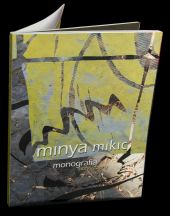
Monography, solo show at Monkdogz gallery
"Art – a Form of Communication"
New York , Ottobre 2008
|
| Communication was always one of primary necessities of human groups. This need, represented by creation of verbal language at the beginning and by writing later, was created milleniums ago together with the need to pass on the knowledge over generations, in form of images which had their cult value and the purpose of the social institution.
...more
|
The picture, from it’s origins, allows also a first step toward elaboration of the personal character.
Figurative art was always the strongest mean of expression and communication in a cultural, social and religious sense across the evolution of the mankind. It always performed it’s ability to communicate through images that makes accessible and comprehensive by all man and all nations independently from their linguistic or social difference, bringing therefore a clear, understandable message easy to pass on and thus usable also for educational and didactic purpose.
With the evolution of the society and technological discoveries, also in field of communication, we assist the considerable changes also in the field of Art, especially regarding techniques of production and re-production.
In a historical period characterized by so called third industrial revolution, deriving from convergence of telecommunication and computer science, which influence all human meanings of expression, are inserted works of young artist Minya.
Minya’s intention is to communicate visually, through her art, the beginning and the evolution of communication itself, from it’s primordial origins with the cave drawings representing the images of hunting to our present style of life where not even analogical technology that allowed reproduction of material things are sufficient and where flows and necessity of communication multiplies to excess

|
solo show at Monkdogz Urban Art gallery
"GAPscape New York"
New York , October 2008
|
|
Minya is an extremely innovative and vastly intelligent artist whose use of texture and symbolism can take the viewer into both the past and future simultaneously as if they are discovering pre-historic petro glyphs next to an object left by some alien traveler from beyond our galaxy.
...more
|
There is something both seductive and primal in her use of form and structure that borders on sexual eloquence. Her use of muted and primary color applications only add to the wonder of experiencing her work. The innate beauty of these works can be found in their continual evolution sparked by light due to the material use and texture of the work. It is as if the works possess a soul, constantly searching for a way to express and re-invent them selves and adapting to their newly placed environment.
"Lettera Internazionale" - 2008
Minya's painting on the cover of the international quarterly.
"GAPscape - Rome"

|
solo show in gallery Tartaruga
Rome, May 2008
by Mario Cappelli
|
| Awaiting Minya’s solo exhibitions in Rome’s Galleria della Tartaruga and subsequently in New York’s Monkdogz Urban Art in Chelsea Art connoisseurs in Italy know this artist who exhibits in Rome and New York, for her previous exhibitions in Italian galleries and abroad.
...more
|
This year Minya has been invited to participate, for the second time after 2003, in the traditional spring exhibition organized by ARGAM - the Association of Roman Galleries of Modern Art. In 2007 she also participated in the KunStart art fair in Bolzano and in Italy she is a member of the prestigious galleries in Rome, Milan and Novara. In New York she exhibits her works in Monkdogz Urban Art gallery in Chelsea. Already in her previous paintings Minya revealed her fascination and interest in the early humans’ attempts of visual communication. By comparing and confronting through her art that communication with modern media and means of communication, she created her recognisable personal expression. While those works continue to charm and intrigue with both their subtlety and artistic quality, in her most recent collection Minya offers even more. Further emphasizing the idea behind the layers of pigment, she gradually pushes her already stylized figures toward entirely abstract form, thus subliming her idea of visual communication. At the exhibition in Monkdogz gallery in Chelsea in September 2007, she gave us a hint of this evolution. While her technique remains characteristic and recognizable, her latest compositions and forms show the progress and maturation of the author’s artistic thought. When Ed McCormack referred to this exhibition in Art & Studio Magazine entitling his article “Monkdogz Fires a Bold Opening Volley Across the Bow of New Season” he actually intuited Minya’s new effort. Not asking for the approval from the spectator’s eye, she maintains the inner beauty of her works which is not condescend but engaging and requiring. That is another reason why her works continue to delight and enthuse even after prolonged and intense observation, revealing new meanings and showing concealed forms. Another thing which enriches the value of her opera is the interactivity with the light. One would hardly expect a work created on a canvas to be so light-interactive. “People often think I exaggerate when I tell them the painting will look different tomorrow morning – but it does!” says Minya. And truly, it is enough to turn on an extra light or close the window blinds, and the works start to look differently – previously hidden forms appear and new shadows materialize. Not an ordinary effect considering it is created with traditional canvas & paint! A versatile and modern artist, Minya creates her works also on a less traditional media – plexiglas. Often these works are composed of two, tree and sometimes even four layers mounted at a distance of 1.5 inches. Transparent ‘empty’ spaces on these works have equal importance as the painted ones, creating together a complex stratification of pigments and shadows on a cold and modern plexiglas surface. The effect of lightness and spontaneity is a result of a careful and meticulous study because the technique does not allow any mistakes and corrections. The opening of the Roman exhibition will be on May 23rd in Galleria della Tartaruga in central via Sistina, right on the top of the famous ‘Spanish steps’, while the New York exhibition will take place at the end of the month of October in Monkdogz Urban Art in Chelsea.
Italia Sera
"Italia Sera" on Minya's solo exhibition in Rome
May 2008
Golf & Eventi
Monthly review "Golf & Eventi" writes about Minya's art
maggio 2007
Ida Mitrano

|
"Transformunication"
solo exhibition at gallery Tartaruga
Rome, May 2006
|
| Minya's rediscovered symbols. To exceed the fractionating of space and linearity of time, recovering them in the synchrony of space and time of her work, is what connotes Minya's art.
...more
|
A reading key, that allows to identify immediately a poetic nucleus of research toward which the artist’s different experiences converge, conducted in various creative fields. Her interest in communication and the necessity to rejoin its segments, recognising them not as the external phenomenon, but on the contrary recognising the profound motivations, are the reasons that determined the choice of the subject that characterizes the current work. This could be an interpretation sufficient to provide simple explanation, but which would turn out to be superficial and reductive, if one doesn’t sense vital and hidden ferments that form the very humus of Minya’s artistic performance, which reveal themselves, in effect, the true substance of the work. The logic that guides the artist’s intervention on canvas, meditated and experimented, at first glance, across preparatory studies, deliberately appears to be somehow apparent, not rigorous, unable to control completely in its complexity the creative process. Not frozen by complete programming of the work, the movement of the artist encounters unexpected inputs, which allows new access to an archetypic imaginary, researched and re-contextualized with great sensibility of the artist. It is also not accidental that the surface of the paintings becomes a screen on which gather together figures, signs, suggestive traces of an almost genetic memory, that seem to re-emerge on canvas as the scene of that possible space-time synchronism, that the artist pursues. A place that becomes magic, burdened with remote symbols, rituality, where everything converses, where everything is in movement, where everything is bursting with life. In fact, Minya’s work not only faces the subject of communication in terms of the evolution of language but also communicates itself, presenting a sedimentation of images that unveil only to the observant, curious eye, ready to relate to a mysterious, antique writing. To the explicit contents, to which we owe the realization of these works, are subtended unknown contents which are to be searched out, discovered through a different way of observation. With the quotations of the cave art, with their animals or stylized human figures, simplified in an efficient, immediate style, submerged in a magma of symbols and re-contextualized across the overlapping of lines positioned according to a certain order or the punctiform pieces, to symbolize the historic transformations of human communication up to appearance of digital technologies, the artist experiments not only different possibilities of communication, but above all offers different perception of reality. To give visibility to this difference, allows to create the premises for a true exchange, for a transversality even subterranean that permits to discover the complexity of the individual. Minya does it using exactly the expressive manners typical of computer media, whose language is synthetically suggested by pixels on the canvas. In that sense, also seriality of an image or the choice of its detail inside the pictorial space can be interpreted as an input to experiment other possible visual, and at the same time mental, journeys. If forms of communication, so intense, are multiple, even more is experience defined in relation with them. And it is, every time, a new experience, an enchanting event. The magic of this event soaks the material surfaces, characterized by thickness and by graffiti which often are revealed only when seen under the certain light, another fundamental element in the artists creative process. The external light, never direct on the painting, becomes an integral part of the work, reveals the hidden content, but creates primarily a game of shadows on canvas, which modifies continuously the use and connotation of the work itself. Minya’s art, constructed on restless transformation of the pictorial vision, connotes itself as metaphor of communication and its mutations in the course of history, but essentially hosts inside itself the mystery of life, and with that, of man.
Claudio Perri

|
"Transformunication"
solo exhibition at gallery Tartaruga
Rome, May 2006
|
| In Minya's paintings more than the colours deliberately monochromatic, are the surfaces, processed with the expertise, to impose themselves powerfully:
...more
|
rough and carved with archaic animals, polished in pearly transparence with fluctuating Egyptian alphabets, excavated like archaeological discoveries, structured by lines and pixels of the video screen, they narrate the communication of man, himself reduced to an archaic symbol. Surfaces that separate to reassemble staggered and to fall apart again, where the magic of light transforms the symbols in visual stimulus which interact with our sensibility, modern and problematic. Surfaces submerged in a meditative silence which contemplates eternal presence of those messages, signs of our precariousness of existence
Irina Subotic

|
"Transformunication"
solo exhibition at gallery Tartaruga
Rome, May 2006
|
|
In dialog established between present artistic thought and traces of old, antic primary civilizations, young artist Minya is trying to maintain balance between universal values and new visual possibilities of the painting.
...more
|
Her researches are based on material, layers of paint and other materials with which she enriches her work, and through witch she realizes rich relief structures. From them are beaming light effects full of enigmatic shadows, especially in conditions of different sources of light underneath which stratified material achieves new meaning and sense. What distinguishes the most Minya's painting is her ability of numerous variations on subject of movement and dramatic changes of forms, in almost monochromatic solutions of noble earthly tones. In that manner the artist establishes the model of communication with a distant archetypes molded in new media and with new ideas and, like in a musical rondo, so close to postmodern repetitions with variations, on her paintings can be felt the language of the modern age, without so usually exaggerated use of modern technology: they are only understood, as it is understood that latent abstraction of her paintings bares also the meanings of recognizable sense. Living in the ambient of the ‘eternal city’ of Rome, young artist comprehensibly felt the sediments and layers of the civilizations as the imperative of her work; in that sense her work can also be read as a dialog with the society to which she herself increasingly and profoundly belongs.
Italia Sera
Following Minya's solo exhibition in February 2006
February 2006
"Transformunication"
Rome, May 2004
by Stefania Misio
Minya is authentic symbolic painter gifted by distinctive sensibility.
...more
Minya likes to accompanies her public toward a emotional three dimensionality thanks to a minimal variations of the material layers which she prepares to subsequently incise decisively her alphabets. Paying attention to the problem of communications the Artist coherently combines research of the visual symbols with the constant exploration of the modes and contents of the complex system of communication. Young but already expert in technique and research Minya is getting increasing number of consents, both from those who believes in painting exclusively as pleasure for the eye, as well from those who think that behind every movement of the brush there should be a big intellectual effort.
JAT review
Serbian national air company writes in its journal an extensive report on Minya
Gradjanski list
novembre 2003


